
Herman Flesvig: Inside the ‘Førstegangstjenesten’ Character Army
The premise sounds like a sketch-comedy dare: one comedian plays four recruits at the Norwegian Armed Forces’ recruit school — a war enthusiast, a spoiled russ, a female male chauvinist and a white multicultural rapper — and asks whether these are really the future protectors of Norway. That is Førstegangstjenesten, the NRK comedy series created by Herman Flesvig, and it became one of the most unlikely streaming phenomena in Norwegian television: two modestly reviewed pilot episodes that drew hundreds of thousands of streams in days and forced the broadcaster to order a full season.
The pilot phenomenon
NRK released the first two episodes on 13 December 2019. The critics were lukewarm — VG gave the show a dice throw of 4, Dagbladet a 3 — but the audience disagreed violently. The two pilots were streamed 370,000 and 335,000 times respectively within days, enormous numbers for a Norwegian comedy on a public broadcaster’s streaming platform. NRK commissioned ten new episodes almost immediately, and when the full season arrived in October 2020 with higher production values, the reviews caught up: a 5 from VG and a rare 6 — a perfect score — from Dagbladet.
Across two seasons and twelve episodes, each running a tight eleven to fourteen minutes, the show did something unusual for sketch-derived comedy: it built a world. The recruit school setting gave the characters a structure to bounce off — the routines, the hierarchy, the absurdity of military life — and the short episodes made it compulsively watchable.

The four faces of Flesvig
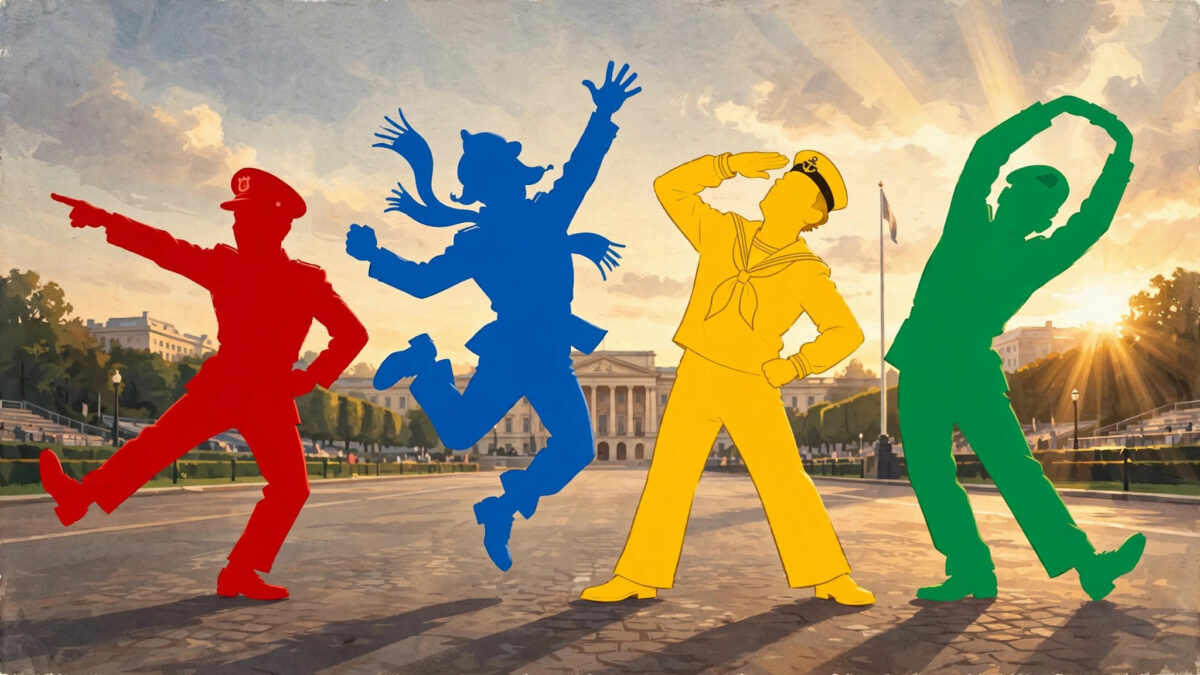
The show’s engine is Flesvig himself, playing the four central recruits. The cast list gives us their names — Ahre-Ketil Lillehagen, Ola Halvorsen, Preben Lohengren and Sæther — but the archetypes are what audiences remember: the war enthusiast who treats basic training like a calling, the spoiled russ who treats it like an inconvenience, the female male chauvinist who weaponises every contradiction in the room, and the white multicultural rapper whose identity is a performance in itself.
What makes the four work is not just the makeup and the voices — though both are formidable — but the writing. Each character is a satire with a specific target: Norwegian masculinity, class privilege, gender politics, cultural appropriation. The comedy lands because the targets are recognisable from civilian life; the army setting just concentrates them. Flesvig switches between the four with a speed that turns scenes into one-man ensemble pieces, and the show’s best moments come when the characters collide with each other — which is to say, when Flesvig collides with himself.
The sketch method
Flesvig’s method is the old character-comedy discipline: find the voice, find the walk, find the worldview, and then let the character embarrass himself. He co-wrote the series with a team including Marit Støre Valeur, Rolf Magne Golten Andersen, Erlend Westnes, Åse Marie Hole and Karsten Fullu, with Westnes directing — but the characters are unmistakably his creations, developed with the obsessive specificity of a comedian who has lived inside each of them.
The show is also an ensemble piece around him. Jonas Kinge Bergland plays Lt. Stølan, the officer trying to maintain order among the chaos, and Mikkel Niva appears as Lauritzen, the military chaplain — the straight men whose job is to be professionally unflappable while Flesvig’s recruits dismantle everything around them. The dynamic works because the authority figures play it real; the comedy needs something solid to push against.
The NRK-to-mainstream path
Førstegangstjenesten matters beyond its jokes because of how it happened. A comedian from Siggerud created a show for NRK’s streaming platform, the critics shrugged, the audience showed up in force, and the broadcaster followed the numbers. It is the streaming-era version of the old television success story — except the audience, not the executives, made the first call.
For Flesvig, the series established him as one of Norway’s defining comedy voices: a character comedian in the classic mould, building a universe one exaggerated Norwegian at a time. The recruits of Førstegangstjenesten may be unfit to protect the country. As comedy characters, they turned out to be exactly what Norwegian television needed.
Satire with a draft card
What elevates Førstegangstjenesten above its sketch-comedy roots is the precision of its targets. Each of the four recruits is a distillation of a recognisable Norwegian type, dropped into the one institution designed to flatten individuality — and the comedy comes from watching the institution fail. The war enthusiast treats conscription as a sacred calling in a country with a complicated relationship to military enthusiasm. The spoiled russ embodies a whole social class encountering its first real authority. The female male chauvinist turns every gender debate in Norwegian public life into a single walking contradiction. And the white multicultural rapper holds up a mirror to a very specific kind of Scandinavian cultural tourism.
The recruit-school setting is the pressure cooker that makes it all work. Eleven-to-fourteen-minute episodes, built for streaming, keep the pace relentless — no sketch overstays, no premise gets explained twice. And because the authority figures play it straight, the satire never feels like punching down: the joke is always on the recruits, on the culture that produced them, and, quietly, on the audience recognising itself. That is why the show survived the jump from viral pilots to a full series, and why its characters outlived the streaming moment that made them. They were never just funny. They were accurate.
The four characters: a field guide
Flesvig plays all four central recruits himself, switching between them with a speed that turns scenes into one-man ensemble pieces. The cast list credits the four as Ahre-Ketil Lillehagen, Ola Halvorsen, Preben Lohengren and Sæther — but the archetypes are what audiences remember, because each is a satire with a specific target:
| Archetype | What the satire targets |
|---|---|
| The war enthusiast | Treats basic training like a sacred calling — a send-up of Norwegian masculinity and the country’s complicated relationship with military enthusiasm. |
| The spoiled russ | Treats conscription like an inconvenience — a whole social class encountering its first real authority. |
| The female male chauvinist | Weaponises every contradiction in the room — every gender debate in Norwegian public life, compressed into a single walking contradiction. |
| The white multicultural rapper | An identity that is a performance in itself — a mirror held up to a very specific kind of Scandinavian cultural tourism. |
What makes the four work is not just the makeup and the voices — though both are formidable — but the writing. The comedy lands because the targets are recognisable from civilian life; the army setting just concentrates them. The show’s best moments come when the characters collide with each other — which is to say, when Flesvig collides with himself.
The world around him is an ensemble too. Jonas Kinge Bergland plays Lt. Stølan, the officer trying to maintain order among the chaos, and Mikkel Niva appears as Lauritzen, the military chaplain — the straight men whose job is to be professionally unflappable while Flesvig’s recruits dismantle everything around them. The dynamic works because the authority figures play it real; the comedy needs something solid to push against, and the satire never feels like punching down because the joke is always on the recruits, on the culture that produced them, and quietly on the audience recognising itself.
Førstegangstjenesten by the numbers
The show’s origin story is the streaming-era version of the old television success story — except the audience, not the executives, made the first call. NRK released the first two episodes on 13 December 2019. The critics were lukewarm — VG gave a dice throw of 4, Dagbladet a 3 — but the audience disagreed violently: the two pilots were streamed 370,000 and 335,000 times respectively within days, enormous numbers for a Norwegian comedy on a public broadcaster’s streaming platform.
NRK commissioned ten new episodes almost immediately. When the full season arrived in October 2020 with higher production values, the reviews caught up: a 5 from VG and a rare 6 — a perfect score — from Dagbladet. Across two seasons and twelve episodes, each running a tight eleven to fourteen minutes, the show did something unusual for sketch-derived comedy: it built a world. The recruit school setting gave the characters a structure to bounce off — the routines, the hierarchy, the absurdity of military life — and the short episodes made it compulsively watchable.
Behind the characters, Flesvig co-wrote the series with a team including Marit Støre Valeur, Rolf Magne Golten Andersen, Erlend Westnes, Åse Marie Hole and Karsten Fullu, with Westnes directing. A comedian from Siggerud created a show for NRK’s streaming platform, the critics shrugged, the audience showed up in force, and the broadcaster followed the numbers.
What comes next for Herman Flesvig
Førstegangstjenesten established Flesvig as one of Norway’s defining comedy voices: a character comedian in the classic mould, building a universe one exaggerated Norwegian at a time. The series matters beyond its jokes because of how it happened — audience-first, streaming-native, critic-proof.
The method is the old character-comedy discipline: find the voice, find the walk, find the worldview, and then let the character embarrass himself. It is a method that travels — the archetypes Flesvig distils are Norwegian in their specifics but recognisable anywhere that class, masculinity and institutional absurdity exist. Whether the next chapter is new characters, new formats or new platforms, the recruits of Førstegangstjenesten may be unfit to protect the country. As comedy characters, they turned out to be exactly what Norwegian television needed — and the comedian who contained all four of them has already proved he can build a world from nothing but voices.
FAQ
How many characters does Herman Flesvig play in Førstegangstjenesten?
Four — all of the central recruits. He switches between them with a speed that turns scenes into one-man ensemble pieces: a war enthusiast, a spoiled russ, a female male chauvinist and a white multicultural rapper.
What are the characters’ names in Førstegangstjenesten?
The cast list credits the four recruits as Ahre-Ketil Lillehagen, Ola Halvorsen, Preben Lohengren and Sæther. Audiences tend to remember them by their archetypes — the war enthusiast, the spoiled russ, the female male chauvinist and the white multicultural rapper — because each is a satire with a specific target.
When did Førstegangstjenesten premiere?
NRK released the first two episodes on 13 December 2019. They were streamed 370,000 and 335,000 times respectively within days — enormous numbers for a Norwegian comedy on a public broadcaster’s streaming platform — and NRK commissioned a full season almost immediately.
How many episodes of Førstegangstjenesten are there?
Twelve episodes across two seasons, each running a tight eleven to fourteen minutes. The full season arrived in October 2020 with higher production values — and markedly better reviews than the pilots: a 5 from VG and a rare perfect 6 from Dagbladet.
Who plays the authority figures in Førstegangstjenesten?
Jonas Kinge Bergland plays Lt. Stølan, the officer trying to maintain order among the chaos, and Mikkel Niva appears as Lauritzen, the military chaplain. They play it straight — the comedy needs something solid to push against.
Is there a third season of Førstegangstjenesten?
The show ran for two seasons and twelve episodes; no third season has been announced in the sources covered here. The series stands as a complete, self-contained world — which may be exactly why its characters outlived the streaming moment that made them.
Sources & Further Reading
Read next: Ylvis: What Are They Doing Now? Life After ‘The Fox’ | Why Fredrik Skavlan Ended Scandinavia’s Biggest Talk Show
