
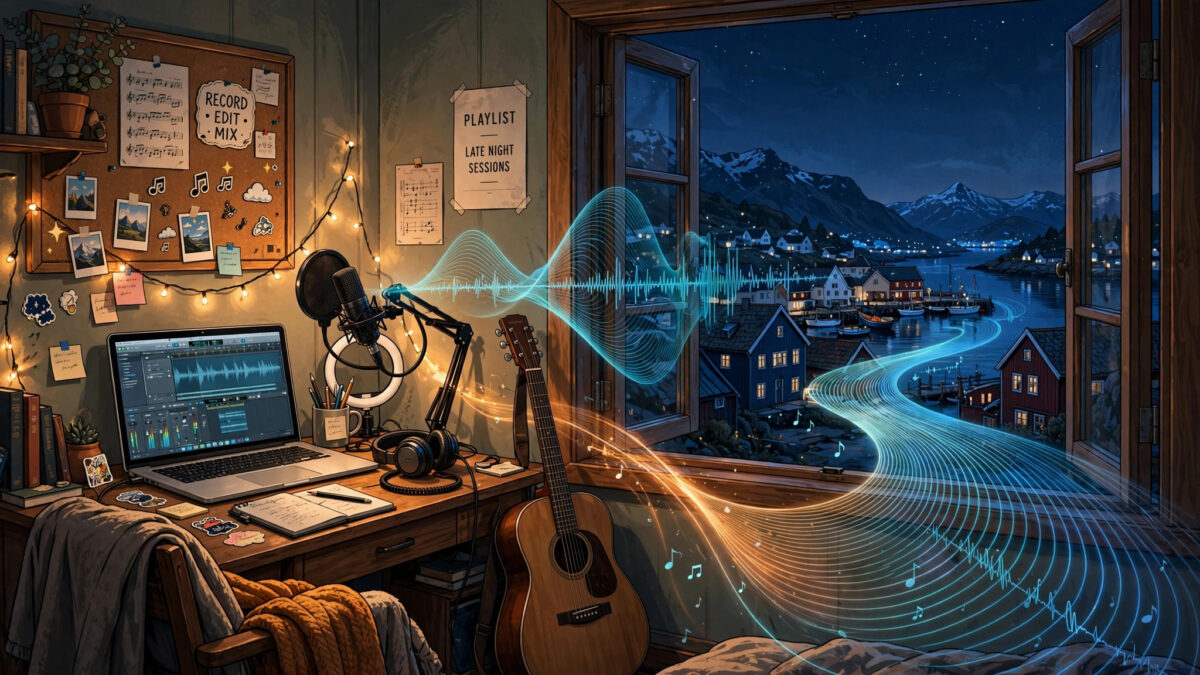
Girl in Red’s Bedroom Recordings: How Marie Ulven Built a Career From Horten
No label. No studio. No co-writers. Just a teenager, a laptop, and a bedroom in Horten, Norway. When Marie Ulven started uploading songs as girl in red, she had none of the things the music industry says a career requires — and that turned out to be the entire point. Her rise from SoundCloud obscurity to global indie stardom is the purest DIY success story of the streaming era, and it was recorded, produced, and released from the same small room where it started.
Horten: “quiet and kinda boring”
Marie Ulven Ringheim was born on February 16, 1999, in Horten, a small coastal town in southeastern Norway. She grew up there with her sisters and her divorced parents, and she has described the town in interviews as “quiet and kinda boring.” Her mother worked in technology; her father was a policeman. There were no instruments in the house — but her grandfather could play guitar and piano, and for Christmas 2012 he gave her first guitar to twelve-year-old Marie. She credits him with sparking her interest in music.
She did not touch the guitar seriously until the following year, when she lost interest in fingerboarding — the miniature-skateboard hobby that had consumed her — and picked it up instead. In high school she briefly considered becoming a teacher. Then, at fourteen, she discovered songwriting, and the teaching plans evaporated. She taught herself piano, guitar, and music production entirely on her own, from the comfort of her bedroom. Nobody in the house was a musician. She simply decided to become one.
The Blue Yeti and the bedroom studio
The girl in red sound has a specific, documented origin in hardware. In 2015, her father gave her a Blue Yeti microphone — the affordable USB mic that became the unofficial symbol of the bedroom-pop generation. Her recording setup, which she later detailed for Spotify for Artists, was almost comically minimal: an Apogee Jam interface with a single USB-to-guitar input so she could play directly into her Mac, the Blue Yeti, a pair of Apple earbuds, and a 13-inch 2013 MacBook running GarageBand.
On that setup she made “i wanna be your girlfriend,” “say anything,” and “summer depression” — the songs that would define a genre. The lo-fi quality was not a limitation she worked around; it was the aesthetic. The intimacy of a voice recorded two feet from a laptop in a Norwegian bedroom became the emotional signature of bedroom pop itself.
“I don’t really write with people”
Ulven’s creative process is as solitary as her setup. “I don’t really write with people,” she told Spotify. “I haven’t really done proper writing sessions yet, but I’m guessing that if you’re not completely 100% comfortable with the people you’re working with, you might not say that one line that you actually wanted to say because you were just like, ‘That’s weird.’ Instead, I’m just like, ‘Okay, I’ll write down whatever because nobody’s going to see this, nobody’s going to hear this.’ I can just work in my own space and be in control.”
That philosophy — write the weird line, because nobody is watching — is only possible alone. In an industry built on writing camps and committee-crafted singles, Ulven’s insistence on total creative control was radical. It also meant her songs arrived with an honesty that polished pop could not fake: lyrics about anxiety, queer longing, and existential dread, delivered in the unguarded voice of someone who genuinely thought nobody was listening.
Lydia X and the name in the crowd
Before girl in red, there was Lydia X — the alias under which Ulven uploaded Norwegian-language songs to SoundCloud starting in 2015. She had quit guitar lessons after six months when her teacher refused to take her interest in songwriting and production seriously. The industry’s loss was the bedroom’s gain.
The name “girl in red” has one of the best origin stories in modern music. In 2017, Ulven realized she was in love with her best friend and tried to find her at a concert. She spotted her in the crowd wearing a red sweater and texted a friend the words “girl in red” to identify her. Nothing came of the crush — but the feeling of romance mixed with longing set the entire direction of the project. Her first song under the new name, “I Wanna Be Your Girlfriend,” was, as she later put it, “totally about a girl.” The early Norwegian songs had been about boys. The girl in red songs were about the truth.
The SoundCloud breakthrough
“I Wanna Be Your Girlfriend” was published to SoundCloud in November 2016. For five months, almost nothing happened — about five thousand streams. Then the Norwegian music site NRK Urørt featured it, and the song exploded. Thousands of streams became hundreds of thousands, and Ulven suddenly had a large online following built entirely from a bedroom upload.
What followed was the classic indie acceleration, except without the label machinery that usually drives it. Two EPs — chapter 1 and chapter 2 — established her as the defining voice of bedroom pop. The New York Times placed “i wanna be your girlfriend” at number 9 on its list of the best songs of 2018 and called her one of the most astute singer-songwriters working in guitar music. Paper magazine named her a queer icon. She toured North America and Europe, played festivals from Lowlands to Øyafestivalen, and was flagged by NME as one of the most hyped acts at The Great Escape in 2019.
The debut album — still on her terms
Her debut album, if i could make it go quiet, arrived in 2021 — and the most telling detail is how it was made. She began recording it in late 2019 and continued through the COVID-19 shutdowns, working in the same solitary way she always had. The album was a coming-of-age record about anxiety, desire, and “trying to understand what the fuck is going on,” as she described it. Taylor Swift declared it “spectacular” on Instagram. The bedroom had gone global without changing its address.
Why the bedroom mattered
The girl in red story is often told as a triumph of the internet — and it is. But it is more precisely a triumph of a room. The bedroom gave Ulven three things no label could: total creative control, total privacy to write honestly, and a sound — intimate, unpolished, immediate — that millions of listeners recognized as the sound of their own inner lives. She did not succeed despite having no label, no studio, and no co-writers. She succeeded because of it.
From Horten to the world stage, Marie Ulven’s career remains the clearest proof of the streaming era’s central promise: that a kid with a laptop, a USB microphone, and something true to say does not need permission anymore. She never asked for it. She just uploaded the song.
From SoundCloud to Columbia: the girl in red timeline
The girl in red bedroom recordings era was never meant to be a career plan — which is exactly why it worked. Here is how the songs made on a 2013 MacBook in Horten travelled to the biggest stages in the world.
| Year | Milestone |
|---|---|
| 2016 | Marie Ulven uploads “i wanna be your girlfriend” to SoundCloud; Norwegian tastemaker site NRK Urørt picks it up and the song starts spreading beyond Horten. |
| 2017 | “summer depression” and “girls” cement her sound; the phrase “bedroom pop” starts attaching itself to her name as the press catches on. |
| 2018 | Chapter 1 EP arrives; standalone single “we fell in love in october” becomes her signature song and, eventually, her first billion-stream record. |
| 2019 | Chapter 2 EP; a sold-out world tour proves the bedroom songs work in rooms of thousands. |
| 2020 | “Midnight Love” and a string of singles keep her visible through the pandemic; she signs with AWAL for her debut album. |
| 2021 | Debut album if i could make it go quiet is released — largely self-produced, and a winner at Norway’s Spellemannprisen (Norwegian Grammys). |
| 2024 | Second album I’M DOING IT AGAIN BABY! arrives via Columbia Records, with “Too Much” and “You Need Me Now?” as singles. |
Girl in red: key facts and numbers
- Born: Marie Ulven Ringheim, February 16, 1999, in Horten, Norway.
- The setup: Blue Yeti microphone (a gift from her father in 2015), an Apogee Jam interface, Apple earbuds, and a 13-inch 2013 MacBook running GarageBand.
- First guitar: given by her grandfather at Christmas 2012; she taught herself guitar, piano, and production with no formal training.
- Streaming scale: “we fell in love in october” has reportedly passed a billion Spotify streams — a staggering figure for a song recorded in a teenager’s bedroom.
- Industry recognition: if i could make it go quiet won Album of the Year at the 2021 Spellemannprisen.
- The name: reportedly came from a text message — a friend trying to find her in a crowd, and her reply: “I’m the girl in red.”
What’s next for girl in red
The I’M DOING IT AGAIN BABY! era moved Marie Ulven further from the bedroom without abandoning what made it special: she remains the principal songwriter and producer of her own records, a rarity for pop artists at her level.
FAQ
Did girl in red really record her music in her bedroom?
Yes. Her breakthrough songs — “i wanna be your girlfriend,” “summer depression,” “girls” — were written, recorded, and produced by Marie Ulven alone in her bedroom in Horten, Norway, using a Blue Yeti microphone, an Apogee Jam interface, and GarageBand on a 2013 MacBook.
What equipment did girl in red use for her bedroom recordings?
The documented setup was minimal: a Blue Yeti USB microphone (given to her by her father in 2015), an Apogee Jam interface for plugging her guitar straight into her Mac, a pair of Apple earbuds for monitoring, and a 13-inch 2013 MacBook running GarageBand.
Did she record her debut album at home too?
Not entirely. While if i could make it go quiet (2021) was reportedly largely self-produced by Ulven, it was made with better resources and collaborators than the SoundCloud-era tracks. The bedroom recordings remain her early EPs and singles from 2016–2019.
Is girl in red still an independent artist?
Her early music was fully independent and self-released. She later partnered with AWAL for her 2021 debut album and signed with Columbia Records for 2024’s I’M DOING IT AGAIN BABY! — while keeping creative control and her songwriting independence.
Who is Lydia X?
Lydia X is the friend behind the girl in red name — the story goes that when a friend was trying to spot Marie Ulven in a crowd, she identified herself by texting that she was “the girl in red,” and the phrase stuck as her artist name.
What genre is girl in red?
She is the defining artist of bedroom pop — lo-fi, guitar-driven indie pop with brutally honest lyrics about love, mental health, and queer identity. Her later albums lean into bigger indie-rock and pop production while keeping the confessional songwriting.
Sources & Further Reading
Read next: Sigrid’s Songwriting: The ‘Don’t Kill My Vibe’ Origin Story | Morten Harket’s Voice: The Technique Behind ‘Take On Me’