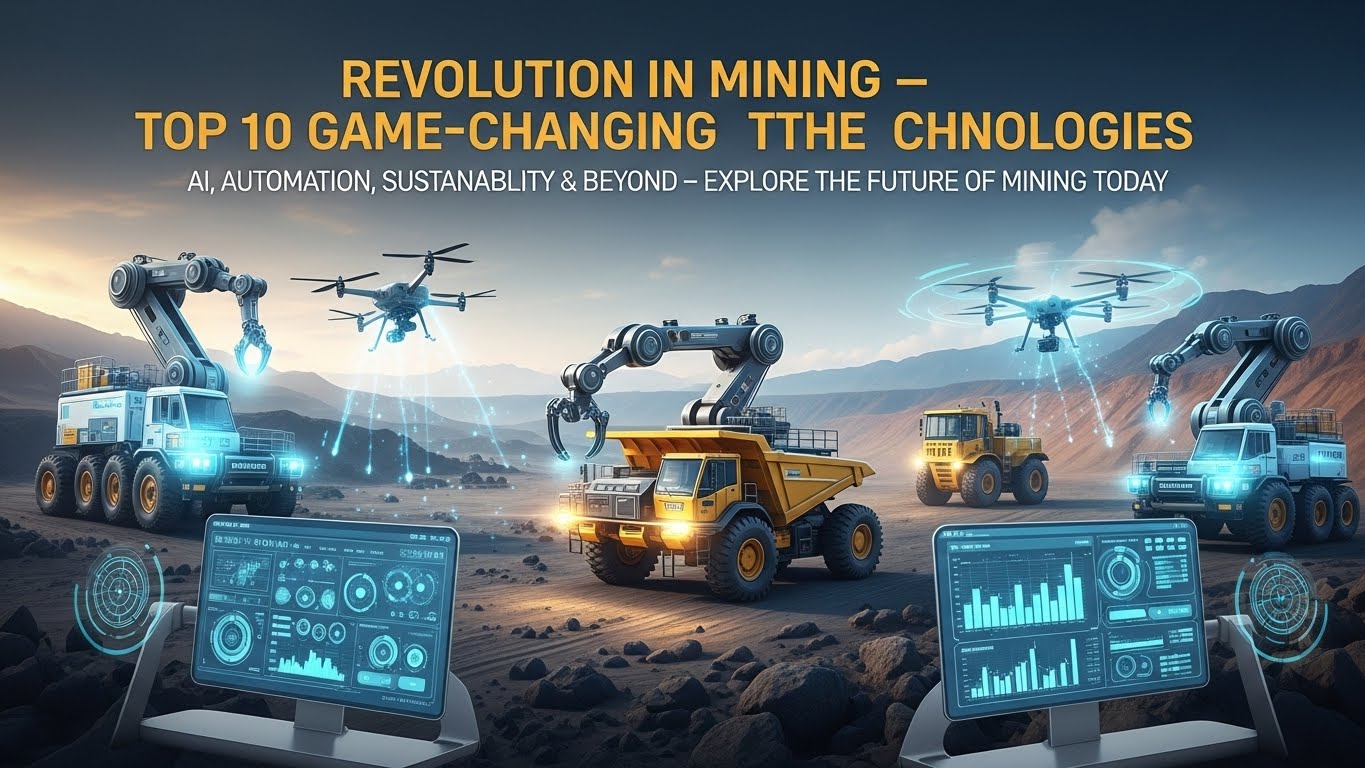
Top 10 Emerging Technologies Revolutionizing the Mining Industry (with FAQs)
The mining industry, one of the world’s oldest and most foundational sectors, is undergoing a profound transformation. Gone are the days of relying solely on manual labor and brute force. Today, a wave of emerging technologies is sweeping through mine sites, enhancing safety, boosting efficiency, and paving the way for a more sustainable future. From autonomous vehicles navigating deep underground tunnels to AI algorithms predicting equipment failure, innovation is reshaping every aspect of mineral extraction.
This article explores the top 10 emerging technologies making the biggest impact on the mining industry. We will examine how each innovation works, its benefits, and its real-world applications, followed by a helpful FAQ section to answer common questions.
1. Automation and Robotics
Automation is arguably the most significant force changing the face of modern mining. It involves using robotic systems to perform tasks traditionally done by humans, often in dangerous or repetitive environments.
Impact and Benefits
Automated systems operate continuously, 24/7, without succumbing to fatigue. This consistency leads to greater operational efficiency and predictable output. Most importantly, removing human operators from hazardous areas, such as unstable underground stopes or active blast zones, dramatically improves safety and reduces the risk of accidents.
- Key Benefits:
- Enhanced worker safety
- Increased productivity and operational uptime
- Reduced operational costs
- Greater precision in tasks like drilling and hauling
Real-World Applications
Leading mining companies are deploying fleets of autonomous haul trucks that navigate complex mine sites using GPS and LiDAR. Automated drill rigs can execute precise drilling patterns without human intervention, while robotic arms are used for tasks like equipment maintenance and mineral sorting.
2. Artificial Intelligence (AI) and Machine Learning (ML)
AI and ML are the brains behind many of the other technologies on this list. These systems analyze vast datasets to identify patterns, make predictions, and optimize processes.
Impact and Benefits
In mining, AI can process geological survey data to pinpoint promising new deposits with greater accuracy. ML algorithms power predictive maintenance systems, alerting operators to potential equipment failures before they happen. This proactive approach minimizes costly downtime and extends the life of critical machinery.
- Key Benefits:
- Improved mineral exploration success rates
- Predictive maintenance reduces equipment downtime
- Optimized processing and resource allocation
- Enhanced decision-making through data analysis
Real-World Applications
AI-driven software is used to create dynamic 3D models of ore bodies, helping engineers plan extraction more effectively. Machine learning also optimizes ventilation systems in underground mines, ensuring safe air quality while minimizing energy consumption.
3. Internet of Things (IoT)
The Internet of Things refers to a network of interconnected sensors, devices, and machinery that collect and exchange data in real-time. In a mine, this creates a fully connected, “smart” environment.
Impact and Benefits
IoT sensors placed on equipment, vehicles, and even personnel can track location, monitor health, and report on operational status. This constant flow of information provides managers with a comprehensive, live overview of the entire operation, enabling them to make quick, informed decisions.
- Key Benefits:
- Real-time monitoring of assets and personnel
- Improved supply chain and logistics management
- Enhanced safety through worker tracking and environmental sensing
- Data collection for performance analysis
Real-World Applications
Wearable IoT devices for miners can monitor vital signs and detect falls, automatically sending an alert in an emergency. Sensors on conveyor belts track volume and flow, helping to prevent blockages and optimize the movement of materials from the mine to the processing plant.
4. Drones and Unmanned Aerial Vehicles (UAVs)
Drones have become an indispensable tool for modern mining operations. Equipped with high-resolution cameras, LiDAR, and other sensors, they provide an aerial perspective that was once costly and difficult to obtain.
Impact and Benefits
UAVs are used for a wide range of tasks, from initial site surveying and exploration to monitoring stockpile volumes and inspecting high-walls for signs of instability. They can cover large, inaccessible areas quickly and safely, delivering accurate data at a fraction of the cost of traditional methods like manned aircraft or ground crews.
- Key Benefits:
- Rapid and cost-effective site surveying
- Improved safety for inspections of hazardous areas
- Accurate stockpile volume measurement
- Environmental monitoring of land and water
Real-World Applications
Mining companies use drones to create detailed topographic maps, conduct regular safety inspections of tailings dams, and monitor the progress of reclamation efforts. Post-blast, a drone can fly over the area to assess fragmentation and ensure the zone is clear.
5. Digital Twins
A digital twin is a virtual, real-time replica of a physical asset, process, or entire mine site. It integrates data from IoT sensors, AI models, and operational systems to mirror the real-world operation in a digital environment.
Impact and Benefits
With a digital twin, operators can run simulations to test new strategies, predict the outcomes of decisions, and train staff without disrupting the live operation. It provides a powerful platform for optimizing everything from extraction sequences to processing plant performance.
- Key Benefits:
- Risk-free process simulation and optimization
- Improved long-term planning and forecasting
- Enhanced training and development platform
- Centralized view of the entire operation
Real-World Applications
A digital twin of a processing plant can be used to test how changes in ore grade will affect output, allowing engineers to adjust settings proactively. A twin of the entire mine can help optimize haul truck routes to reduce fuel consumption and cycle times.
6. Advanced Data Analytics
While related to AI, advanced data analytics focuses specifically on turning raw data into actionable insights. Mines generate terabytes of data daily, and analytics tools are essential for making sense of it all.
Impact and Benefits
By analyzing historical and real-time data, mining companies can identify inefficiencies, understand the root causes of production bottlenecks, and benchmark performance. This data-driven approach supports a culture of continuous improvement across the organization.
- Key Benefits:
- Identification of operational inefficiencies
- Better understanding of geological variability
- Improved financial forecasting and resource management
- Evidence-based decision-making
Real-World Applications
Analytics platforms integrate data from drilling, blasting, and hauling to find correlations that impact overall productivity. For example, analysis might reveal that a specific drill pattern leads to better rock fragmentation, which in turn improves loader efficiency.
7. Sustainable Extraction Technologies
As the world shifts toward a greener economy, the mining industry is developing technologies to reduce its environmental footprint. This includes everything from waterless processing methods to innovative ways of managing waste.
Impact and Benefits
Sustainable technologies help mines comply with stricter environmental regulations, reduce their consumption of resources like water and energy, and improve their social license to operate. This focus on sustainability is crucial for the long-term viability of the industry.
- Key Benefits:
- Reduced water and energy consumption
- Minimized environmental impact
- Improved waste management and tailings stability
- Enhanced corporate social responsibility
Real-World Applications
Dry stacking is a technique for dewatering tailings (mine waste) and stacking them as a solid mass, which reduces water use and the risk of dam failure. Other innovations include using renewable energy sources like solar and wind to power mine sites.
8. Electrification of Mining Equipment
The move away from diesel-powered equipment toward battery-electric vehicles (BEVs) is a major trend, particularly in underground mining.
Impact and Benefits
Electric vehicles produce zero direct emissions, which significantly improves air quality underground and reduces the need for complex and energy-intensive ventilation systems. They also generate less heat and noise, creating a safer and more comfortable working environment.
- Key Benefits:
- Elimination of diesel particulate matter underground
- Reduced ventilation costs and energy use
- Lower maintenance costs compared to diesel engines
- Quieter operation improves communication and safety
Real-World Applications
Several equipment manufacturers now offer a range of electric underground loaders, trucks, and drills. Some mines are designing their entire infrastructure around electric fleets, complete with fast-charging stations and battery-swapping systems.
9. Advanced Material Sensing and Sorting
These technologies use sensors to identify the properties of ore on a particle-by-particle basis and sort it accordingly. This allows mines to separate valuable minerals from waste rock much earlier in the process.
Impact and Benefits
By pre-concentrating the ore before it enters the energy-intensive grinding and processing stages, mines can save enormous amounts of energy and water. This “gangue rejection” improves efficiency and reduces the volume of tailings produced.
- Key Benefits:
- Increased energy and water efficiency
- Higher-grade feed for the processing plant
- Reduced volume of waste material (tailings)
- Potential to re-process old waste dumps
Real-World Applications
Sensor-based sorters using X-ray transmission (XRT), lasers, and electromagnetic sensors are installed on conveyor belts. As ore passes by, the system identifies and separates high-grade material from low-grade or waste rock using precise jets of air.
10. Remote Operations Centers (ROCs)
Remote Operations Centers centralize the control and monitoring of a mine site in a safe, distant location, often in a major city. From an ROC, operators can control everything from autonomous trucks and drills to processing plants.
Impact and Benefits
ROCs remove personnel from the physical mine site, improving safety and offering a better work-life balance for employees. Centralizing expertise also allows a small team of specialists to oversee multiple operations, driving consistency and sharing best practices.
- Key Benefits:
- Greatly improved worker safety and quality of life
- Centralized control enhances operational consistency
- Ability to attract a wider talent pool
- Reduced need for on-site infrastructure
Real-World Applications
Major mining companies have established state-of-the-art ROCs thousands of kilometers away from their mines. Operators in these centers use joystick controls and large screen displays to manage fleets of automated equipment in real-time, 24 hours a day.
Frequently Asked Questions (FAQs)
Q1: Are these technologies replacing human workers in the mining industry?
While some traditional roles are being automated, these technologies are also creating new jobs that require different skills. Roles in data science, robotics, remote equipment operation, and systems maintenance are in high demand. The focus is shifting from manual labor to knowledge-based work, making mining a more high-tech career path.
Q2: How do these technologies improve mine safety?
They improve safety primarily by removing people from dangerous environments. Automation allows machines to work in unstable ground, drones inspect hazardous areas from a distance, and remote operation centers let staff control equipment from the safety of an office. Wearable IoT devices also monitor worker health and location in real-time.
Q3: What is the biggest barrier to adopting these new technologies?
The biggest barriers are often the high initial capital investment and the need for a significant cultural shift within the organization. Integrating new systems with legacy infrastructure can be complex and requires careful planning. Furthermore, there is a need to upskill and retrain the existing workforce to manage and work alongside these new technologies.
Q4: Can smaller mining companies afford to implement these technologies?
While large-scale automation might be out of reach for some, many of these technologies are becoming more accessible. Drones, for instance, offer a low-cost entry point for improving surveying and inspection. Many software solutions are available on a subscription basis (SaaS), reducing the upfront investment. Smaller companies can adopt technology incrementally to see a return on investment.
Q5: How does technology make mining more sustainable?
Technology contributes to sustainability in several ways. Electrification reduces carbon emissions and improves air quality. Sensor-based sorting and process optimization reduce energy and water consumption. AI and data analytics help mines plan for more efficient resource use and better manage waste, while drones assist in monitoring environmental compliance and land reclamation efforts.