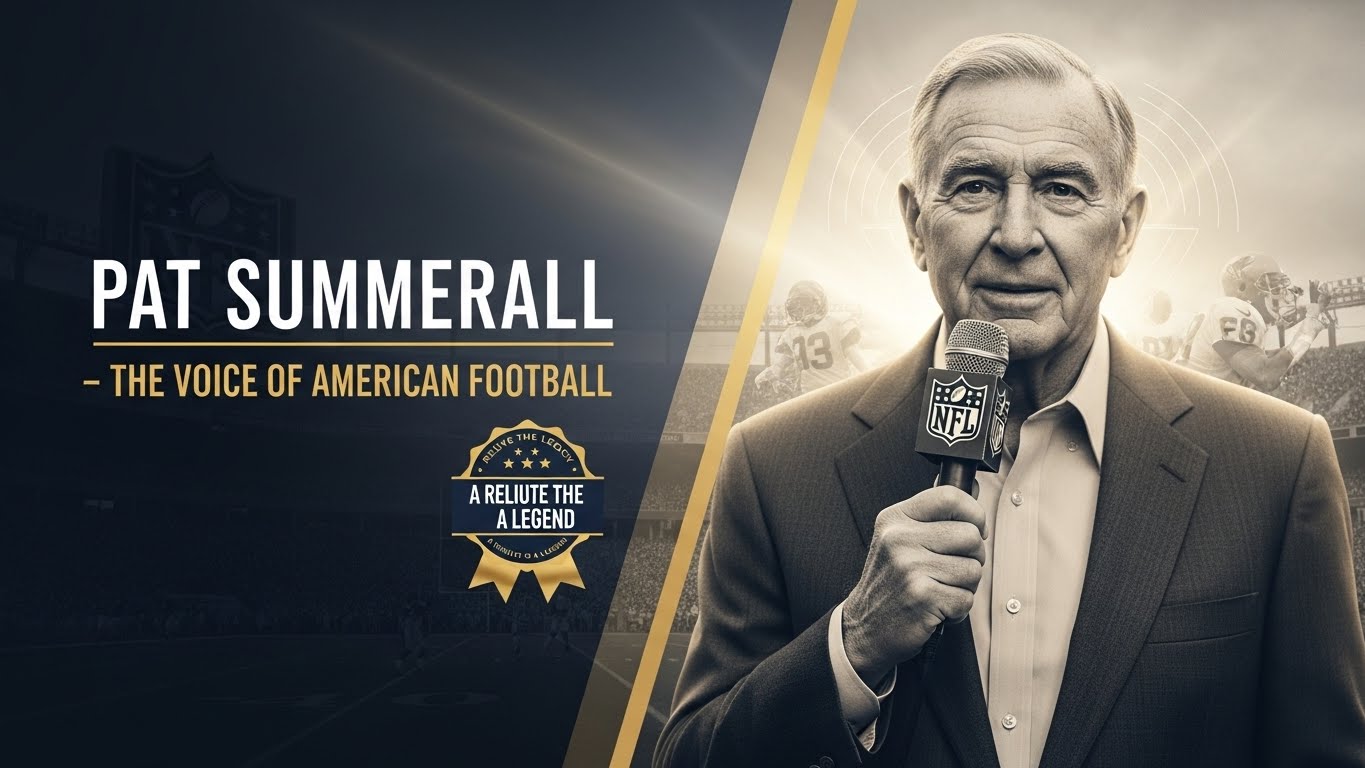
Pat Summerall: The Golden Voice That Defined an NFL Era
For nearly four decades, Sunday afternoons in America had a specific soundtrack. It wasn’t a song, but a voice. It was a deep, rich baritone that commanded authority without ever raising its volume. It was a voice that knew exactly when to speak, and perhaps more importantly, when to stay silent. That voice belonged to Pat Summerall.
To millions of viewers, Summerall was the steady hand guiding them through the biggest moments in sports history. From the grassy fairways of Augusta National to the chaotic gridirons of sixteen Super Bowls, his delivery was the gold standard of sports broadcasting. He brought a sense of calm to the frenzy of the NFL, serving as the perfect counterweight to the explosive energy of his longtime partner, John Madden.
But before he became the preeminent play-by-play announcer of his generation, Summerall lived a life entirely different yet equally impressive. He was a professional athlete who played in one of the most famous games in football history. Later, he faced personal demons that nearly cost him everything, only to find redemption in the later stages of his life. To understand the legend of the broadcast booth, one must understand the man who sat behind the microphone—a man whose life was defined by resilience, transformation, and an uncanny ability to connect with an audience by saying less, not more.
From the Gridiron to the Giants
Before he was the voice of the NFL, George Allen “Pat” Summerall was a star on the field. Born in Lake City, Florida, in 1930, he overcame a challenging childhood marked by his parents’ separation to become a standout athlete. His physical prowess led him to the University of Arkansas, where he played for the Razorbacks as a defensive end and a placekicker.
His college career was successful enough to catch the eye of the Detroit Lions, who drafted him in the fourth round of the 1952 NFL Draft. However, a broken arm in the preseason meant his rookie year never truly began in Detroit. He was traded to the Chicago Cardinals, where he spent five seasons honing his craft. But it was his trade to the New York Giants in 1958 that cemented his legacy as a player.
The Kick in the Snow
Summerall’s time with the Giants coincided with the team’s rise to national prominence. The 1958 season culminated in a moment that is still replayed in highlight reels today. In the final regular-season game against the Cleveland Browns, playing through a snowstorm at Yankee Stadium, the Giants needed a win to force a playoff game for the Eastern Conference title.
With just minutes remaining and the score tied, the Giants stalled. Head coach Jim Lee Howell and offensive coordinator Vince Lombardi were debating play calls when Summerall convinced them to let him kick. From 49 yards out—a massive distance for the era, especially in swirling snow and wind—Summerall connected. The Giants won 13-10. This victory set up a playoff game against the Baltimore Colts, often referred to as “The Greatest Game Ever Played.” While Summerall’s broadcasting career eventually overshadowed his playing days, that kick in the snow proved he possessed the icy veins necessary for high-pressure situations—a trait that would serve him well in the broadcast booth.
The Transition to Broadcasting
Retiring from football after the 1961 season, Summerall did not immediately jump into the lead chair. Like many former players, he started with color commentary. His smooth delivery and deep knowledge of the game made him a natural fit for CBS radio. By 1964, he had moved to television, initially working as a color analyst.
It is a rare feat for a former player to successfully transition from analyst to play-by-play announcer. Usually, the “ex-jock” provides the insight while a trained broadcaster handles the mechanics of the game. Summerall, however, had a rhythmic, minimalist style that suited play-by-play perfectly. CBS recognized this versatility and eventually moved him to the play-by-play role in 1974.
The Brookshier Years
Before Madden, there was Brookshier. Summerall was paired with former Philadelphia Eagles defensive back Tom Brookshier. The duo became popular for their conversational, “guys at the bar” style of commentary. They had genuine chemistry, often engaging in banter that felt less like a formal broadcast and more like two friends watching a game. While this partnership was successful and beloved by fans, it was merely the prelude to the partnership that would change sports television forever.
Summerall and Madden: The Perfect Pair
In 1981, CBS executives made a decision that would define the next two decades of football coverage. They paired the understated, unflappable Summerall with a former Oakland Raiders coach known for his wild gestures, boisterous personality, and fear of flying: John Madden.
On paper, it was a clash of styles. Summerall was the straight man, the buttoned-up professional with the succinct delivery. Madden was the colorful eccentric who used terms like “Boom!” and “Doink!” and drew wild diagrams on the telestrator. In practice, however, it was magic.
Chemistry in the Booth
The dynamic worked because Summerall was secure enough in his talent to let Madden shine. He understood that his role was to set the table so Madden could feast. Summerall would provide the essential information—down, distance, ball carrier—in as few words as possible, leaving the rest of the airtime for Madden’s analysis and antics.
This partnership wasn’t just about contrasting personalities; it was about mutual respect. Summerall’s brevity allowed Madden the space to educate the audience. If Madden went on a tangent about the offensive line or the sweat on a player’s jersey, Summerall would gently guide the broadcast back to the action with a simple, grounding sentence. They became the soundtrack of the NFL’s biggest games, calling eight Super Bowls together for CBS and later Fox.
When Fox Sports outbid CBS for the NFC television rights in 1994, it was considered a massive gamble. To gain instant credibility, Fox hired Summerall and Madden. The move signaled to viewers that despite the new network logo, the premier football experience remained the same.
The Art of Minimalism
“Less is more.” It is a cliché in writing and art, but in broadcasting, it is a discipline that few master. Summerall was the undisputed king of minimalism. He did not feel the need to fill every second of silence with chatter. He trusted the roar of the crowd and the visuals on the screen to tell half the story.
Signature Style
Summerall’s style was characterized by his economy of words. He didn’t scream “Touchdown!” with manufactured excitement. A simple, resonant “Touchdown, Dallas” was often all he said, letting the moment breathe. This restraint gave his words more weight. When Summerall raised his voice or showed excitement, the viewer knew something truly extraordinary had happened.
His versatility extended beyond football. Summerall was a staple of CBS’s tennis coverage at the U.S. Open and its golf coverage at the Masters. At Augusta National, his whispered delivery was revered. His ability to capture the tension of a putt on the 18th green without stepping on the moment is still studied by aspiring broadcasters today. He brought dignity to every event he covered, treating a first-round tennis match with the same professional reverence as the Super Bowl.
Battles off the Screen
While Summerall projected an image of calm control to millions of viewers, his private life was unraveling. For years, he struggled with severe alcoholism. The lifestyle of a traveling broadcaster—nights in hotels, dinners with clients, and the high-pressure environment—fueled a habit that began during his playing days.
Summerall was a “functioning” alcoholic. He rarely missed assignments and maintained his professional demeanor on air. However, off the air, his health and relationships were deteriorating. His liver was failing, and his family was watching him slowly destroy himself.
The Turning Point
In 1992, after broadcasting the Masters, Summerall faced an intervention. A group led by former NFL commissioner Pete Rozelle and Summerall’s own daughter, formidable broadcaster Suzy Kolber, and close friends confronted him. It was a letter from his daughter, telling him she was ashamed of him, that finally pierced his denial.
He checked into the Betty Ford Center, a decision that saved his life. During his recovery, Summerall found more than just sobriety; he found faith. He became a born-again Christian and credited his spiritual awakening with giving him the strength to maintain his sobriety. He later underwent a liver transplant in 2004, a procedure that granted him nearly another decade of life. He became an advocate for recovery, speaking openly about his addiction to help others facing similar battles.
A Legacy That Endures
Pat Summerall passed away on April 16, 2013, at the age of 82. The outpouring of grief from the sports world was immense. John Madden, who had traveled the country with Summerall on the “Madden Cruiser” bus for years, said of his partner, “Pat was my best friend. I will miss him so much.”
His accolades were numerous. He was inducted into the National Sportscasters and Sportswriters Association Hall of Fame. The NFL honored him with the Pete Rozelle Radio-Television Award. But his true legacy lies in the memories of the fans.
Why He Mattered
Summerall represents a golden era of broadcasting that prioritized the game over the personality in the booth. Modern broadcasting often leans toward high energy and constant analysis. Summerall proved that a broadcaster could be a beloved figure by being a calm narrator rather than the main character.
He bridged the gap between the gritty, black-and-white era of the NFL and the glossy, high-production spectacle it is today. He was there for the “Ice Bowl,” and he was there for the rise of the West Coast Offense. Through all the changes in the game, the one constant was that reassuring, deep voice.
The Last Word
Pat Summerall’s life was a three-act play of athletic achievement, broadcasting dominance, and personal redemption. He was a man who reached the pinnacle of two competitive fields and survived a battle with addiction that claimed many of his peers.
For generations of sports fans, hearing Pat Summerall’s voice meant that it was Sunday, the game was big, and everything was right in the world. He didn’t just call the game; he elevated it. In a medium defined by noise, Pat Summerall stood out by mastering the silence, proving that sometimes the most powerful thing you can say is just enough.